
Nature · 18 October 2026 · 5 dk okuma · 0 okuma
The Danube Delta: A Journey Into Europe's Wildest Wetland
Pelicans at dawn, reed channels that swallow the map and fishing villages untouched by time: an insider's guide to the Danube Delta, Europe's wildest wetland.
There is a moment, about twenty minutes after your boat leaves the main channel, when the world simply goes quiet. The engine drops to a murmur, the reeds close in on both sides, and the only sounds left are the wingbeats of herons and the soft slap of water against the hull. This is the Danube Delta, and nothing in Europe quite prepares you for it.
After a journey of almost 3,000 kilometres across ten countries, the Danube fans out into a labyrinth of channels, lakes, floating reed islands and sandbanks before it finally meets the Black Sea. Most of this delta lies in Romania, and it is one of the largest and best-preserved wetlands on the continent. It has been a UNESCO World Heritage Site and a biosphere reserve since 1991, and it remains, in the truest sense, wild.
Why the Danube Delta Feels Like Another Planet
The delta is a living landscape: it shifts with every flood, every season, every year. Roads are few and boats are the real way of getting around. Villages such as Crișan, Mila 23 or Sfântu Gheorghe are reached by water, and life there still follows the rhythm of fishing, reed cutting and long summer evenings.
The river splits into three main arms, each with its own personality:
- Chilia, the northern branch, which carries most of the water and forms part of the border with Ukraine.
- Sulina, the central, straightened arm used by ships, ending in the old port town of Sulina.
- Sfântu Gheorghe, the southern branch, the oldest and most winding, ending in a remote village and a wild beach.
A Paradise for Birds (and Patient Travellers)
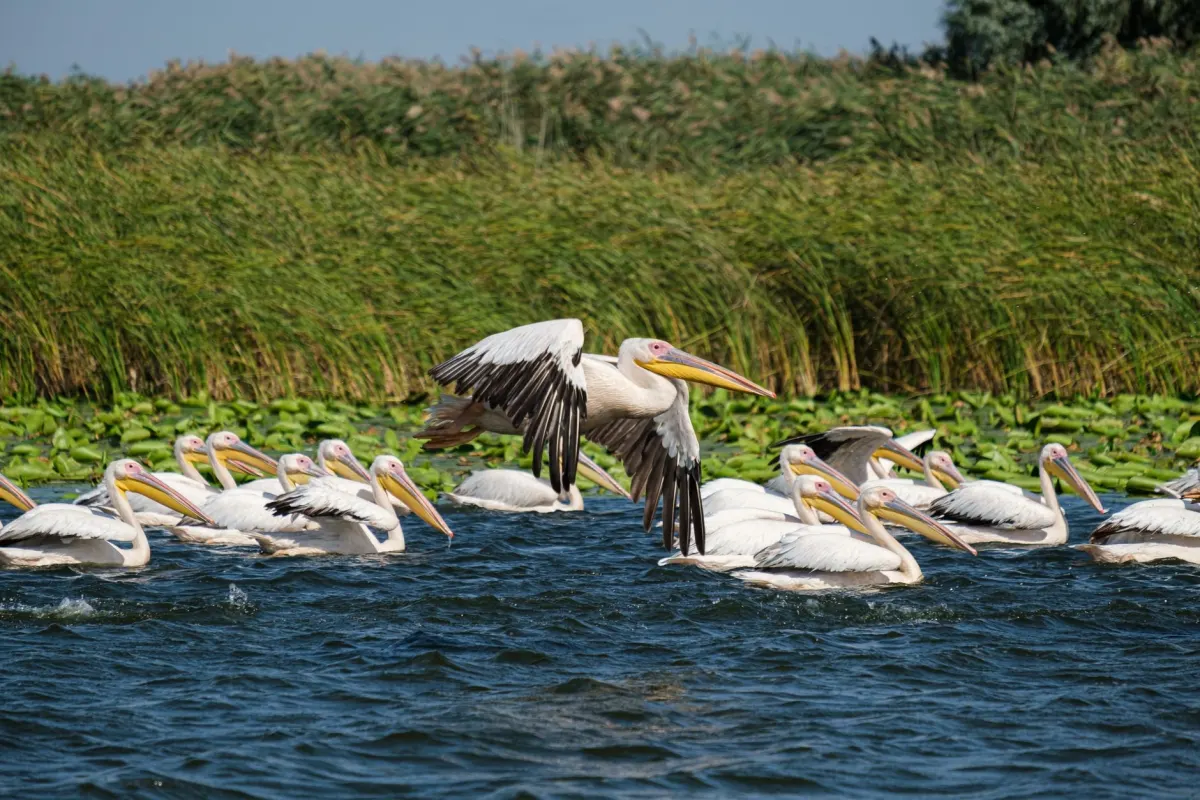
The delta is one of the great birding destinations of Europe, with more than 300 species recorded over the year. The undisputed stars are the pelicans: the great white pelican nests here in large colonies, and the rarer Dalmatian pelican can also be seen. Watching a flock lift off a lake at sunrise, wings flashing white and black, is the kind of image that stays with you for years.
Look out, too, for glossy ibis, spoonbills, pygmy cormorants, egrets, kingfishers and white-tailed eagles. Spring and early summer, roughly from late April to June, are usually the most rewarding months for birds, as migrants arrive and colonies are busy. Late summer brings warm water and lazy afternoons, while autumn adds golden reeds and passage migrants. Conditions vary from year to year, so it is worth planning with someone who knows the season.
How to explore
The traditional gateway is Tulcea, a river town roughly four to five hours by car from Bucharest, depending on traffic. From there, you continue by boat. Larger boats follow the main channels, but the magic is in the smaller craft: a quiet launch or a traditional rowing boat that can slip into the narrow canals where the big vessels cannot follow. Many visitors choose a local guide who knows the lakes, the nesting areas and, crucially, the rules of the reserve.
Beyond the Water: Forests, Dunes and the Sea
The delta is not only water and reeds. Near the village of Letea lies the Letea Forest, one of the northernmost subtropical-style forests in Europe, with climbing plants twisting around old oaks and wild horses roaming the sand dunes nearby. Parts of it are strictly protected, so access is limited and best arranged with an authorised guide.
At the end of the central arm, Sulina is a delightful oddity: a former free port where the European Commission of the Danube once had its headquarters in the 19th century. Its old lighthouse, faded villas and multinational cemetery tell the story of sailors and traders from across Europe. A little further on, a broad sandy beach marks the point where river and sea finally meet.
The Flavours and People of the Delta
Delta cooking is simple, honest and unforgettable. Expect ciorbă de pește, a sour fish soup, fish grilled over open flames, and saramură, fish served in a garlicky brine with polenta. Many of the communities here are Lipovans, descendants of Old Believers who settled in the region centuries ago, and you may notice their distinctive wooden churches and painted houses along the water.
Insider Tips for a Delta Escape
- Give it time. A day trip is possible, but one or two nights let you be on the water at dawn and dusk, when wildlife is most active.
- Pack for nature. Light long sleeves, insect repellent, sun protection, binoculars and a light jacket for early mornings on the water.
- Respect the reserve. Some areas are closed during nesting season. Keep your distance from colonies and let your boatman set the pace.
- Stay flexible. Wind and water levels can change plans. A good itinerary always leaves room for the delta to surprise you.
Travel to the Delta in Private Comfort
The road to Tulcea is long, but it can be a pleasure rather than a chore. With a private chauffeur, you leave Bucharest at your own pace, stop where you like, and arrive rested and ready for the water. For a multi-day journey to the Danube Delta, our team can arrange a private chauffeur and help with the details on request through our concierge service. And if you want a first taste of the great river closer to home, take a look at our Danube boat tour.
Birlikte planlayalım
Bunun sizin için organize edilmesini ister misiniz?
Tarihlerinizi bildirin — size sabit fiyatlı özel bir plan gönderelim.