Nature · 7 October 2026 · 4 min lexim · 1 lexime
The Iron Gates and the Danube Gorge: Where the River Turns Wild
Towering cliffs, the narrow Cauldrons and the giant stone face of King Decebalus: discover the Iron Gates, where the Danube cuts through the Carpathians.
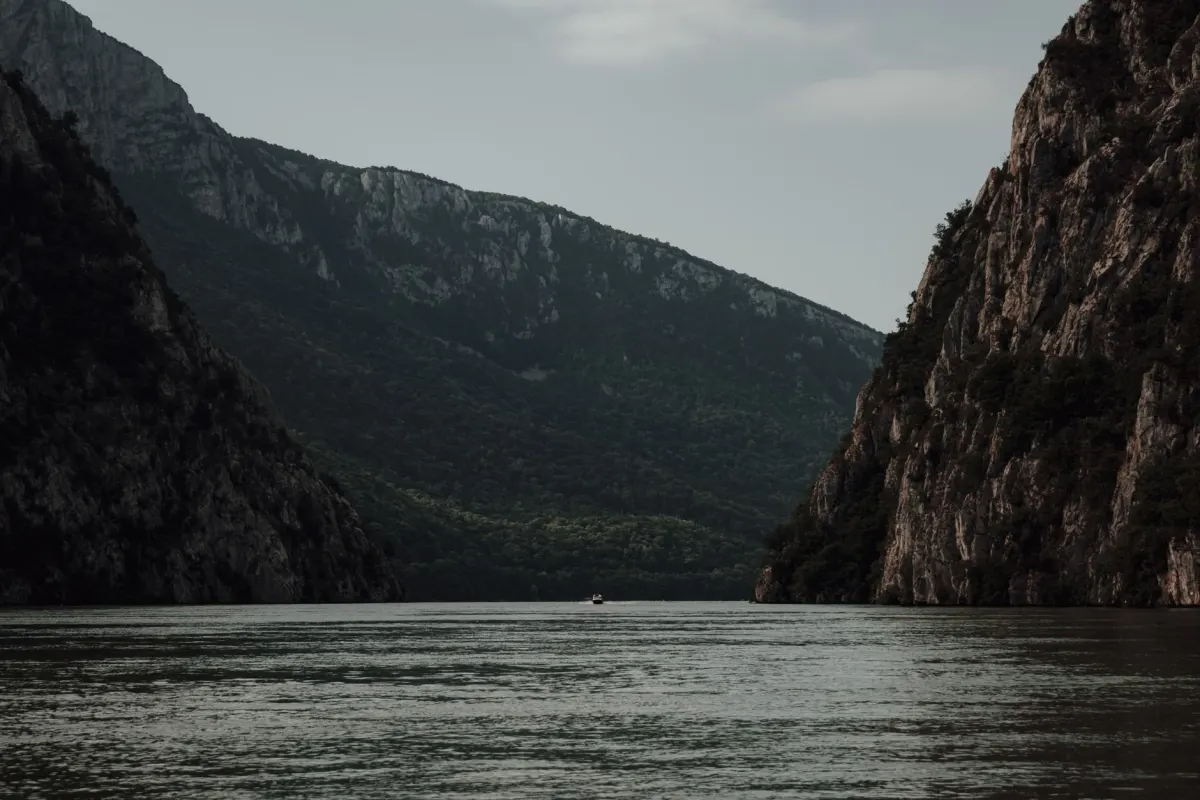
For most of its journey, the Danube is a broad, majestic river. But in south-western Romania, on the border with Serbia, it does something extraordinary: it forces its way through the Carpathian Mountains, squeezing between limestone cliffs that rise hundreds of metres above the water. This is the Danube Gorge, known as the Iron Gates, and it is one of the most dramatic river landscapes in Europe.
A River Through the Mountains
The gorge stretches for more than 100 kilometres, from the area around Baziaș to the great dam near Drobeta-Turnu Severin. Along the way, the river alternates between wide, lake-like basins and narrow passages where the cliffs close in on both banks. On the Romanian side, much of this landscape is protected as the Iron Gates Natural Park, while the Serbian bank forms the Đerdap National Park.
For centuries, these waters were feared by sailors, full of rapids, rocks and whirlpools. Today, after the construction of the dams, the river is calmer and deeper, but no less spectacular.
The Cauldrons: The Danube at Its Narrowest
The highlight of the gorge is the stretch known as the Cazane, or Cauldrons. The Great Cauldrons and Small Cauldrons are the narrowest parts of the Danube's entire course, where the river is confined between sheer rock walls. Seen from a small boat, with the cliffs towering overhead, the scale is humbling.
Boat trips along this section usually depart from villages such as Dubova or Eșelnița, or from the town of Orșova. Conditions on the water, departure points and seasons depend on local operators and the weather, so it is wise to plan with flexibility.
Decebalus: A King Carved in Stone
As your boat glides into the Small Cauldrons, a giant face appears on the Romanian bank: the rock sculpture of Decebalus, the last king of the Dacians, who fought against the Roman Empire before Dacia was conquered by Emperor Trajan in the early second century AD.
Carved directly into the cliff between 1994 and 2004, the sculpture is around 55 metres high and is often described as the tallest rock sculpture in Europe. Below the face, a Latin inscription records the project and its patron. It is a relatively modern work, but its setting, rising straight out of the river, gives it a powerful, almost mythical presence.
Monasteries, Roman Traces and Lost Islands
Mraconia Monastery
Just a short distance from the Decebalus sculpture, the small Mraconia Monastery stands at the water's edge. The original monastery was lost over the centuries, and the area was later affected by the creation of the dam lake; the present church was built more recently, and its setting, framed by cliffs and water, is one of the most photographed in the gorge.
Tabula Traiana
On the Serbian bank, best seen from the water, lies the Tabula Traiana, a Roman memorial plaque carved into the rock in the time of Emperor Trajan, linked to the road built along the river during his campaigns against the Dacians. When the dam raised the water level, the plaque was moved higher up the cliff to preserve it.
Ada Kaleh: the island beneath the water
Until the early 1970s, an island called Ada Kaleh lay in the Danube near Orșova, home to a Turkish community, a mosque, fortifications and orchards. It disappeared beneath the waters when the Iron Gates I hydroelectric dam, built jointly by Romania and Yugoslavia, raised the river level. Old Orșova was also flooded and the town was rebuilt on higher ground. Locals still speak of the island with nostalgia.
On Land: Viewpoints and Trails
- Viewpoints along the riverside road between Orșova and Moldova Nouă offer magnificent panoramas over the Cauldrons and the opposite bank.
- Ciucaru Mare, the cliff above the Great Cauldrons, can be climbed on a marked trail for those with good fitness and shoes, rewarding hikers with sweeping views.
- Drobeta-Turnu Severin, at the end of the gorge, has the remains of the famous Roman bridge of Apollodorus of Damascus and a medieval fortress.
When to Go
Late spring to early autumn is the best period for boat trips and walks, with long days and warm weather. Summer can be hot, so mornings and late afternoons are ideal on the water. Outside the main season, some boat services and guesthouses may operate on a reduced basis.
Travel to the Iron Gates Privately
The Iron Gates lie roughly 350 to 400 kilometres from Bucharest, and the riverside road along the gorge is one of the most scenic drives in Romania. With a private chauffeur, you can stop at every viewpoint and meet your boat without worrying about timings. We do not offer a fixed tour to the Iron Gates, but a multi-day journey with a private chauffeur can be arranged on request through our concierge, perhaps combined with the gorges and waterfalls of Banat.
Planifikojeni me ne
Dëshironi që ta organizojmë ne për Ju?
Na tregoni datat — ju dërgojmë një plan privat me çmime fikse.