Bucharest · 29 October 2026 · 4 min de leitura · 2 de leitura
Calea Victoriei: A Walk Down Bucharest's Most Elegant Avenue
Palaces, museums, churches and the square where 1989 changed everything: Calea Victoriei is Bucharest's grand avenue and the perfect way to read the city.
If Bucharest had a red carpet, it would be Calea Victoriei. For more than three centuries this avenue has been the city's stage: princes rode along it, aristocrats paraded on it, revolutionaries filled it, and today it remains the most elegant stretch of Bucharest. Walk it from end to end and you will read the city's story like the chapters of a book, from the Old Town in the south to Victoriei Square in the north.
From wooden road to Victory Avenue
At the end of the seventeenth century, Prince Constantin Brâncoveanu ordered a road built from the centre of Bucharest towards his palace at Mogoșoaia, just north of the city. The road was paved with wooden beams, and so it became known as Podul Mogoșoaiei, the Mogoșoaia Bridge. Boyars built their mansions along it, and it quickly became the most fashionable address in town.
In 1878, after Romania's victory in the War of Independence, the street was renamed Calea Victoriei, Victory Avenue, in honour of the returning troops who marched along it. The name, and the sense of occasion, have stayed ever since.
The southern end: banks and museums
Start near the river Dâmbovița, at the edge of the Old Town. Here two monumental buildings set the tone. The CEC Palace, with its glass dome and grand arched entrance, was built for the national savings bank at the turn of the twentieth century and is one of the finest examples of Bucharest's Belle Époque style. Across the street, the former Post Office Palace now houses the National History Museum of Romania, home of the national treasure and a full-size cast of Trajan's Column.
Palaces and officers' clubs
A few minutes further north, the Cercul Militar Național, the National Military Circle, rises in sculpted stone. Built as a club for army officers in the early twentieth century, it is one of the most photogenic buildings on the avenue, especially in the late afternoon light. Just beyond, near Revolution Square, the charming Kretzulescu Church, a red-brick jewel from the early eighteenth century, invites a short pause.
Revolution Square: where history turned
The heart of Calea Victoriei is Piața Revoluției, Revolution Square. Few places in Europe carry so much twentieth-century history in one view.
- The former Royal Palace, now the National Museum of Art of Romania, with superb collections of Romanian and European art.
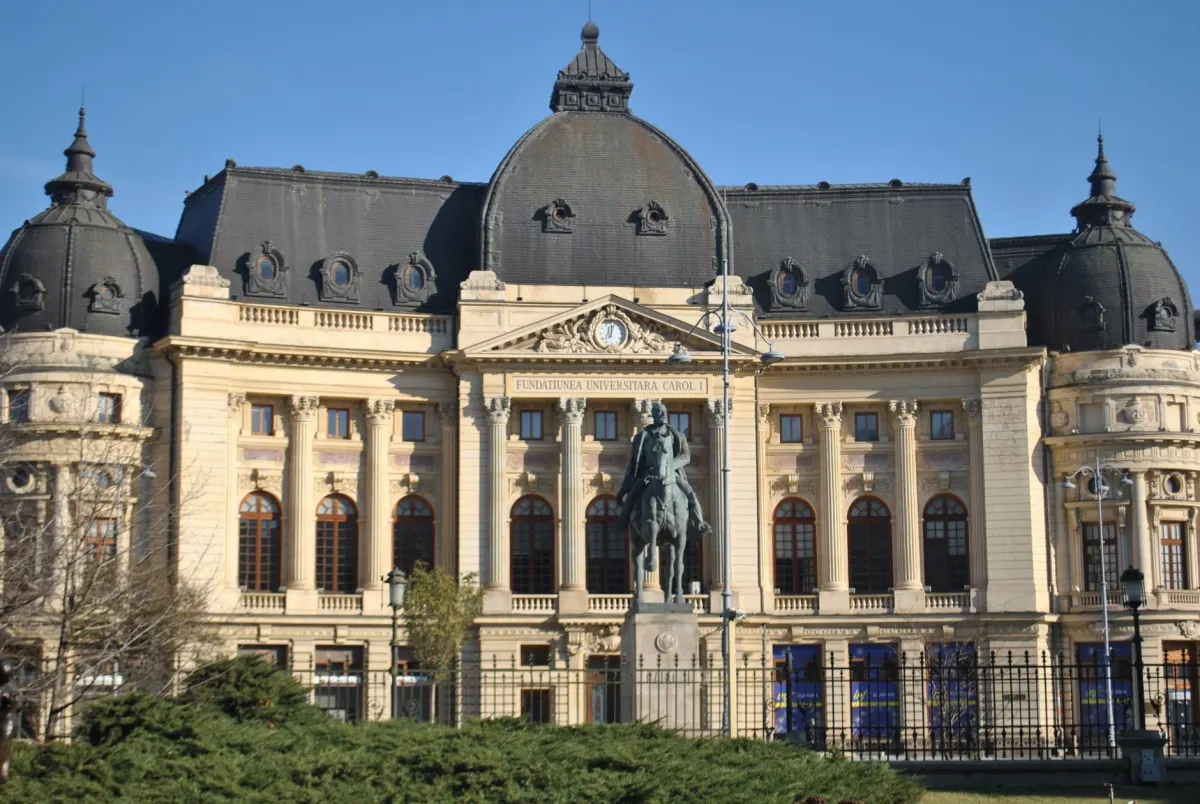
- The Central University Library, originally the Carol I University Foundation, restored after it was badly damaged in 1989.
- The former Central Committee building, from whose balcony Nicolae Ceaușescu gave his last speech on 21 December 1989, before fleeing by helicopter from its roof the next day.
- The Memorial of Rebirth, the striking modern monument dedicated to those who died in the revolution.
Stand quietly in the square for a moment. The contrast between royal grandeur, communist power and the hope of 1989 is what makes this spot so powerful.
The Athenaeum and the literary quarter
Just beside the square, behind a small garden, stands the Romanian Athenaeum, Bucharest's beloved concert hall, with its domed roof and Ionic columns. Even if you are not attending a concert, the exterior alone is worth the detour. The surrounding streets once housed writers' clubs, literary cafés and publishers, and some of that bohemian spirit lingers in the area's bookshops and cafés.
The northern stretch: mansions and memories
As you continue north, the avenue becomes quieter and more residential, lined with nineteenth-century mansions. Look for the Cantacuzino Palace, an exuberant Beaux-Arts residence with a shell-shaped glass canopy over its entrance. Today it houses the George Enescu National Museum, dedicated to Romania's greatest composer. A little further along, other aristocratic houses have become galleries, clubs and institutions, each with its own story.
The walk ends at Piața Victoriei, Victoriei Square, home to the Romanian government and the Grigore Antipa Natural History Museum. From here, the broad Kiseleff Road leads on towards the Arc de Triomphe and the city's great parks.
Tips for enjoying Calea Victoriei
- Walk it in sections. The full length is a few kilometres. Combine walking with a car to enjoy the best stretches without tiring yourself.
- Look up. Many of the finest details, from caryatids to wrought-iron balconies, are above street level.
- Visit on a summer weekend. On selected weekends the avenue is often closed to traffic and becomes a pedestrian promenade with events. Check the city's announcements for dates.
- Make time for museums. The National Museum of Art alone deserves a few hours. Check opening hours before you go.
Experience the avenue in style
Calea Victoriei was made for arriving in style, and there is no better way to honour that tradition than with a chauffeur at your service. Our private Bucharest city tour combines leisurely walks along its finest stretches with a comfortable ride between landmarks. For a more personal pace, simply reserve a private chauffeur and let us bring the car around whenever you are ready for the next chapter.
Planeie connosco
Quer que tratemos disto por si?
Indique-nos as suas datas — enviamos um plano privado com preços fixos.