Transylvania · 9 November 2026 · 4 min. leestijd · 0 leestijd
Transylvania's Saxon Fortified Churches: Biertan, Viscri, Prejmer
Churches built like castles in quiet villages: discover Biertan, Viscri and Prejmer, the UNESCO-listed Saxon fortified churches at the heart of Transylvania.
Drive into almost any village in southern Transylvania and you will see it before anything else: a church rising above the rooftops, ringed by thick walls, towers and battlements. These are the Saxon fortified churches, and there is nothing quite like them anywhere else in Europe.
The Transylvanian Saxons, German-speaking settlers invited by the Hungarian kings from the twelfth century onwards, built prosperous farming villages and market towns across the region. Exposed to raids, and without the resources for a castle in every village, they turned their churches into fortresses. When danger approached, the whole community retreated behind the walls with food, livestock and valuables, and waited.
Several hundred of these fortified churches survive in varying condition. Seven villages with fortified churches are inscribed together on the UNESCO World Heritage list: Biertan, Câlnic, Dârjiu, Prejmer, Saschiz, Valea Viilor and Viscri. Here are three of the most rewarding.
Biertan: the grand one
For several centuries Biertan was the seat of the Lutheran bishop of Transylvania, and it shows. Its late Gothic hall church sits on a hill in the centre of the village, protected by three rings of walls and a series of towers. Climb the covered wooden staircase to the church and step inside to see a richly carved altarpiece and an extraordinary sacristy door fitted with an elaborate lock mechanism, famous for its many bolts.
Biertan's most charming story belongs to a small tower in the walls, traditionally known as the "marriage prison." According to local tradition, couples who wanted to divorce were shut in here together for some time, with a single bed, one plate and one spoon, to work things out. The legend says that very few marriages ended in divorce. Whether it is entirely true or not, it is told with great affection.
Viscri: the soulful one
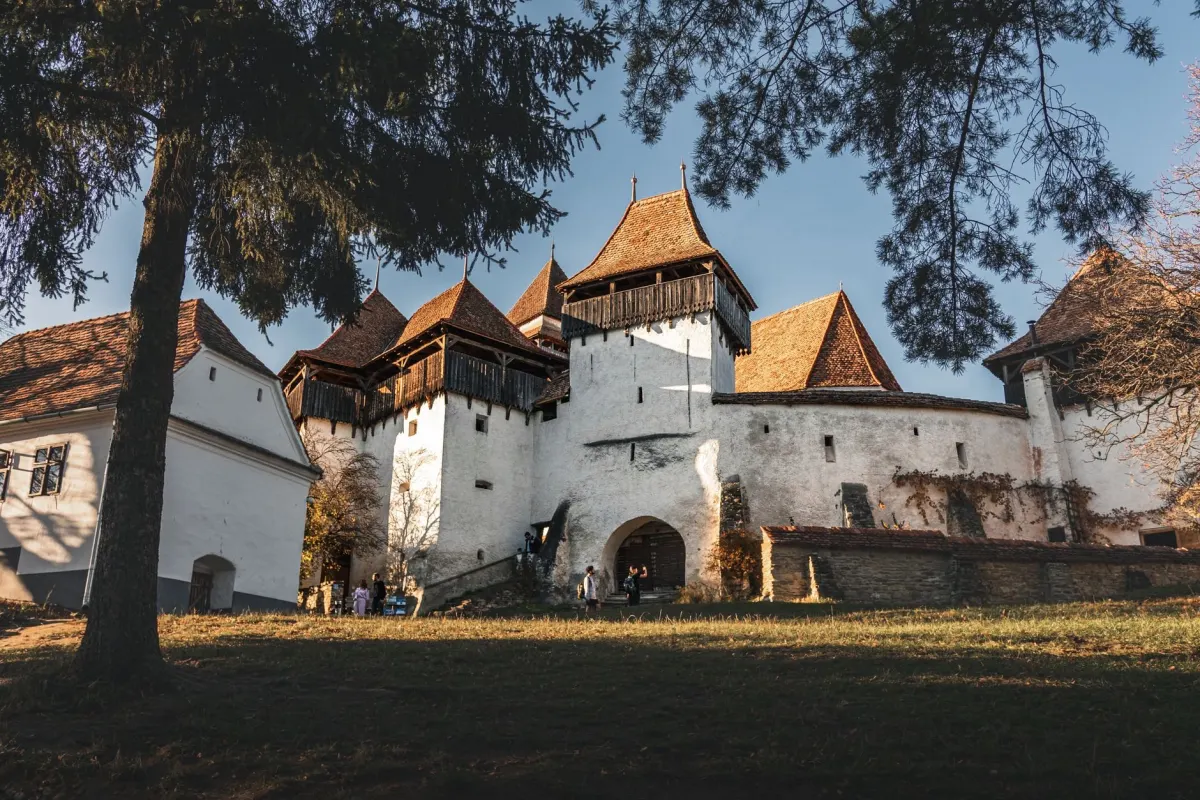
Viscri is a single long village street of pastel houses, grassy verges and walnut trees, where geese wander and horse carts are still part of daily life. At the end of it, on a small rise, stands its white fortified church, simple, sturdy and deeply photogenic.
The village became internationally known thanks to King Charles III, who has long championed the protection of Transylvania's rural heritage and owns a traditional house here. Viscri is also a model of community-led conservation: houses restored with lime, clay and traditional techniques, local crafts such as felted slippers and blacksmith work, and a quiet way of life that visitors are asked to respect. Inside the fortifications, a small museum tells the story of Saxon village life.
Prejmer: the mighty one
Close to Brașov, Prejmer is the largest and most impressive fortified church in the region and one of the best preserved in Southeast Europe. Its origins go back to the Teutonic Knights in the early thirteenth century, and its church has an unusual Greek-cross plan.
What makes Prejmer unforgettable are its massive circular walls, which hold some 270 small rooms stacked on several levels and reached by wooden stairs and galleries. Each family in the village had its own room, where provisions were stored and where they sheltered during a siege. Walking the wooden walkways feels like exploring a medieval apartment block, and it is a powerful reminder of how communal survival once was.
Others worth a detour
- Saschiz, near Sighișoara, with a slender clock tower echoing Sighișoara's own and a fortress ruin on the hill above.
- Câlnic, near Sebeș, where the fortress grew around the residence of a local nobleman.
- Valea Viilor and Dârjiu, the latter with remarkable medieval wall paintings, built by the Székely community.
- Hărman, also near Brașov, a fine companion to Prejmer.
Practical notes
- Many churches are looked after by a local caretaker or by the Evangelical Church community. Opening times can be limited, especially outside summer, and some are only opened on request. Check ahead whenever you can.
- A small entrance fee usually supports conservation. Carrying some cash is wise.
- These are places of worship and living villages. Dress respectfully and keep voices low.
- Village roads can be narrow and sometimes unpaved for the final stretch, so a comfortable vehicle and an experienced driver help.
Explore the Saxon villages privately with Kartas
The beauty of this region lies in the in-between: the lanes, the hay meadows, the unexpected tower glimpsed across a valley. That is exactly what a group bus cannot give you. Prejmer lies just outside Brașov, which our Transylvania castles tour already visits, while Biertan, Viscri and the other villages can be explored with a private chauffeur arranged on request through our concierge. No group, no fixed timetable, just Transylvania at the pace it deserves.
Plan het samen met ons
Wilt u dit door ons laten regelen?
Laat ons uw data weten — wij sturen u een persoonlijk plan met vaste prijzen.