Bucharest · 1 November 2026 · 5 min. leestijd · 1 leestijd
Palace of the Parliament: An Insider's Guide to Bucharest's Giant
The Palace of the Parliament is the world's heaviest building and Bucharest's most debated landmark. Here is how to see it, understand it and enjoy it properly.
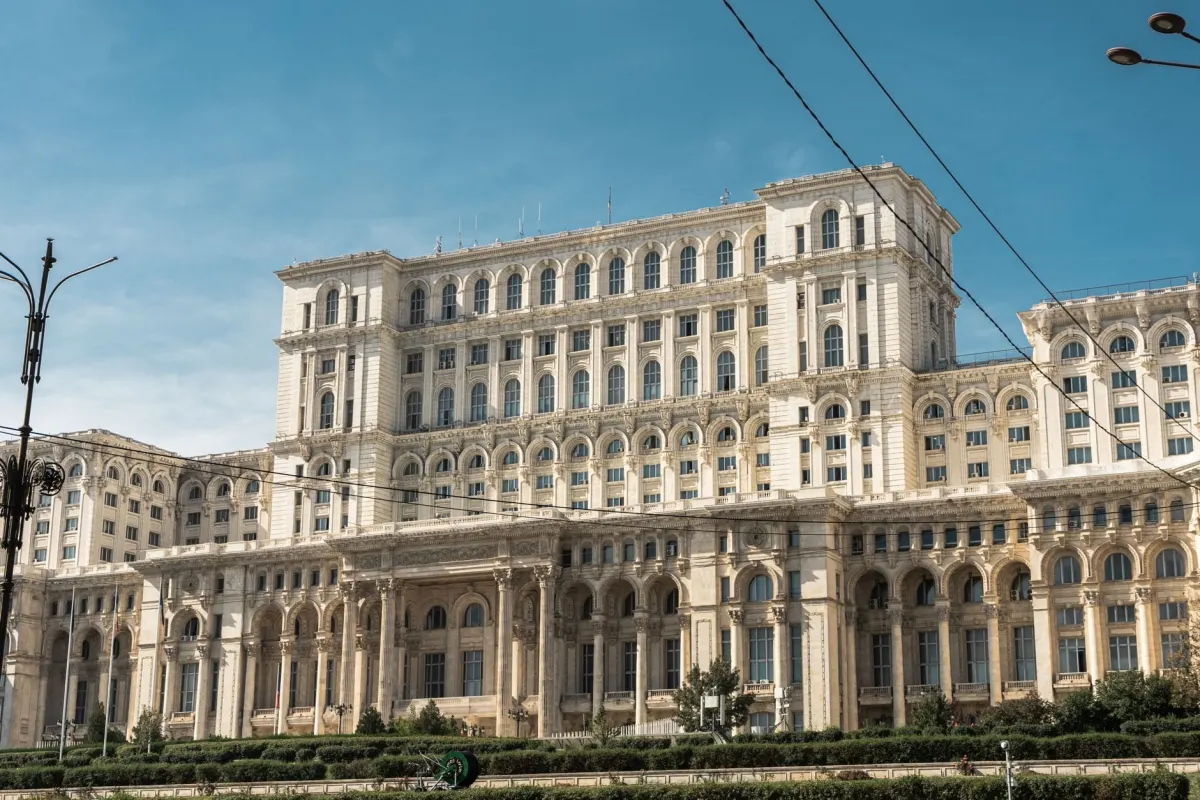
Nothing quite prepares you for the first sight of it. You turn onto the long, fountain-lined boulevard, the trees part, and there it is: a wall of white stone and columns so vast that it seems to bend the horizon. The Palace of the Parliament is the building every visitor to Bucharest comes to see, and the one every Bucharester has an opinion about. Love it or not, it is impossible to understand modern Romania without walking through its doors.
A building born of one man's ambition
Construction began in 1984, at the height of Nicolae Ceaușescu's rule. Originally called the House of the Republic and popularly known as the House of the People, it was meant to be the crowning piece of a new political and administrative centre. To make room for it, a large part of the historic district around Uranus Hill was demolished, including homes, churches and entire streets, and tens of thousands of people were relocated.
The project was led by a young architect, Anca Petrescu, supported by a large team of architects and an enormous workforce that laboured around the clock. When the regime fell in December 1989, the palace was still unfinished. After years of debate about what to do with it, the new democracy moved in: today it houses both chambers of the Romanian Parliament, conference centres and the National Museum of Contemporary Art.
Why "the heaviest building in the world"?
Guinness World Records lists the Palace of the Parliament as the heaviest building on the planet, and it is regularly described as one of the largest administrative buildings anywhere. The weight comes from the materials: tonnes of marble, steel, bronze, crystal and solid wood, almost all of it sourced in Romania. Ceaușescu wanted the building to be a showcase of national resources and craftsmanship, and it shows in every corridor.
The figures quoted for its size are dizzying, with more than a thousand rooms spread over many floors above and below ground, but the numbers matter less than the sensation of standing inside. Ceilings disappear upwards, staircases seem designed for processions rather than people, and the silence of the empty halls is strangely moving.
What you see on the guided tour
The interior can only be visited on a guided tour, and only a small fraction of the building is open to the public. Even so, the route is spectacular. Expect to see:
- Grand halls with carpets woven to fit the floors exactly, some so large they had to be made on site.
- Crystal chandeliers of extraordinary size, glittering above polished marble.
- Carved wooden ceilings and gilded details inspired by traditional Romanian motifs.
- The famous balcony overlooking Unirii Boulevard, with one of the most theatrical city views in Europe.
A favourite story among guides: Ceaușescu never got to speak from that balcony. One of the first famous figures to greet a crowd from it was Michael Jackson, during his 1992 tour, who is widely reported to have shouted a cheerful "Hello, Budapest!" to the people of Bucharest.
Practical tips for your visit
- Book ahead. Tours run in several languages, but places are limited and parliamentary activity can change the schedule. Reserving in advance is strongly recommended.
- Bring your passport or ID. Security is similar to an airport, and identification is required for entry.
- Choose comfortable shoes. Even the standard route involves long corridors and plenty of stairs.
- Check opening hours before you go, as official events can close the building at short notice.
The boulevard that frames it
The palace was never meant to stand alone. It sits at the head of Unirii Boulevard, originally named the Boulevard of the Victory of Socialism, a grand axis designed to be slightly longer and wider than the Champs-Élysées. Lined with ornate apartment blocks and fountains, it is the backbone of what Romanians still call the Civic Centre. Driving its length at dusk, as the palace lights up behind you, is one of the most cinematic moments Bucharest has to offer.
Where to get the best views
For the classic postcard shot, stand at the far end of the boulevard near Piața Unirii and look back towards the palace. Constitution Square, directly in front of the main façade, gives you its full scale. The surrounding grounds and the area near the National Museum of Contemporary Art offer quieter angles, and at night the floodlit façade becomes pure theatre.
A monument that tells two stories
Ask a local about the palace and you will hear two versions. One is about loss: the old neighbourhoods, the churches moved or destroyed, the hardship of the 1980s, when ordinary Romanians queued for basic food while marble was cut for the palace. The other is about pride in the skill of the craftsmen who built it, many of whom poured their best work into its halls. A good guide will give you both, and that is what makes a visit so rewarding. It is not just a building, it is a conversation about history, power and memory.
See it the Kartas way
The Palace of the Parliament is the perfect centrepiece of a day in Bucharest, especially when you do not have to think about logistics. On our private Bucharest city tour, your chauffeur takes you along Unirii Boulevard, drops you at the entrance for your guided visit and is waiting the moment you step out, ready to continue to the Old Town or the elegant villas of the north. Prefer to design the day yourself? Book a private chauffeur by the hour and let Bucharest unfold at your own pace.
Plan het samen met ons
Wilt u dit door ons laten regelen?
Laat ons uw data weten — wij sturen u een persoonlijk plan met vaste prijzen.