Bucharest · 22 October 2026 · 4 min lesetid · 1 leser
Little Paris: The Belle Époque Architecture of Bucharest
Why was Bucharest called Little Paris? Discover the Belle Époque palaces, boulevards and villas that earned the Romanian capital its most famous nickname.
Ask any Romanian grandparent about old Bucharest and you will hear the phrase sooner or later: Micul Paris, Little Paris. Between the late nineteenth century and the Second World War, the city looked towards France for its taste, its fashion and above all its architecture. The result is a capital where, on the right street at the right hour, you could easily believe you were on the banks of the Seine.
Why Paris?
In the nineteenth century, Romania was a young state looking to define itself. The union of Wallachia and Moldavia in 1859, independence in 1878 and the proclamation of the kingdom in 1881 brought new confidence and new wealth. Many Romanian aristocrats and intellectuals had studied in France, spoke French fluently and admired Parisian culture. Romanian is a Romance language too, and the cultural kinship felt natural.
When the capital needed banks, ministries, theatres and palaces worthy of a modern European kingdom, it often turned to French architects or to Romanians trained at the École des Beaux-Arts in Paris. Wide boulevards were opened through the old city, and Bucharest acquired a new, cosmopolitan face.
The landmarks of Little Paris
The Romanian Athenaeum
Designed by the French architect Albert Galleron and inaugurated in 1888, the Romanian Athenaeum is perhaps the most beloved symbol of the era. Its dome and temple-like portico would look at home in any French capital of culture, and its concert hall remains the heart of the city's musical life.
The CEC Palace
On Calea Victoriei, the CEC Palace, completed at the turn of the twentieth century to designs by French architect Paul Gottereau, is a showpiece of eclectic grandeur, with a glass and metal dome and a monumental arched entrance. Gottereau also designed the Carol I University Foundation, today part of the Central University Library on Revolution Square.
The Palace of Justice
Along the Dâmbovița river, the Palace of Justice, designed by French architects including Albert Ballu, was completed in the 1890s. Its richly sculpted façade, with allegorical figures, is one of the finest of its kind in the city.
The Arc de Triomphe
Nothing says Little Paris quite like Bucharest's own Arc de Triomphe, standing at the northern end of Kiseleff Road. The present stone arch, designed by Petre Antonescu and inaugurated in 1936, honours Romania's soldiers of the First World War and the creation of Greater Romania. Seen at the end of the tree-lined avenue, it is an unmistakable nod to its Parisian cousin.
The mansions and villas
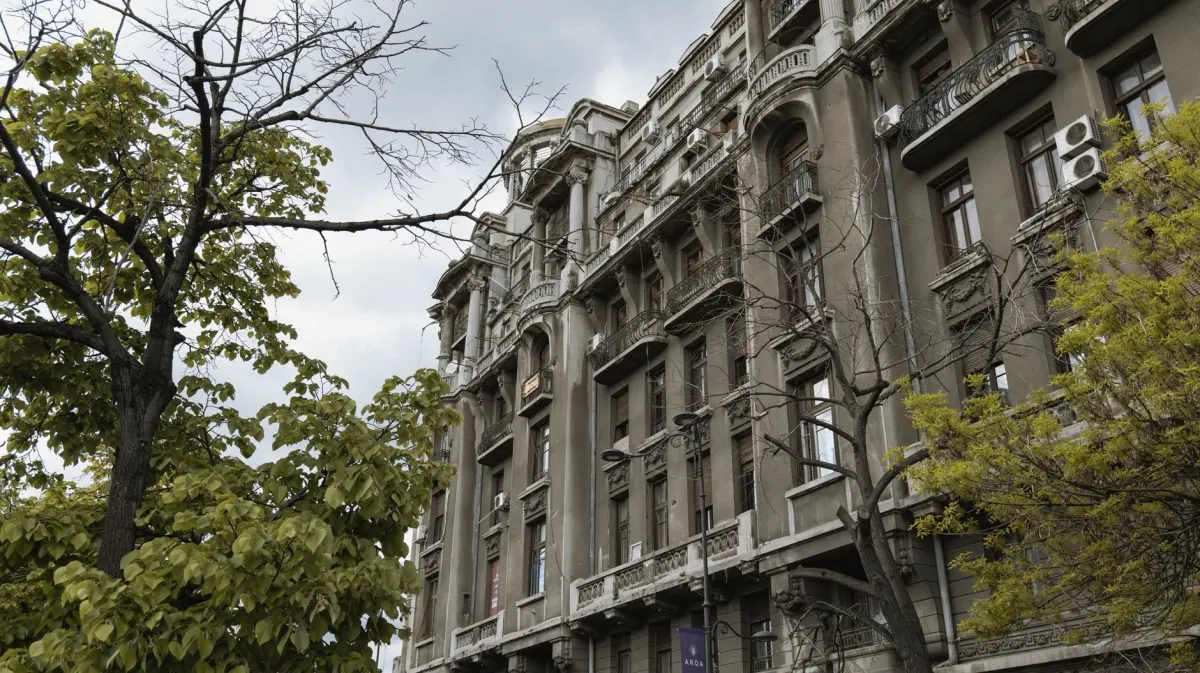
Beyond the public buildings, the spirit of Little Paris lives on in private residences. Along Calea Victoriei, the Cantacuzino Palace, with its sculpted façade and shell-shaped glass canopy, is a Beaux-Arts fantasy that now houses the George Enescu National Museum. In the northern quarters, around Kiseleff Road, Dorobanți and Primăverii, and in the leafy streets near Lascăr Catargiu Boulevard, you will find villas with mansard roofs, wrought-iron balconies and graceful front gardens.
Look closely and you will notice how many have been lovingly restored, while others still wait for their second life. Both tell part of the city's story.
A Romanian answer to Paris
Bucharest did not only copy France. In the late nineteenth century, architect Ion Mincu led a search for a national style, drawing on Brâncovenesc churches, monasteries and peasant houses. This Neo-Romanian style, with its carved stone, loggias, arches and ceramic decoration, appears in schools, villas and public buildings across the city. Seeing French Beaux-Arts and Neo-Romanian buildings side by side is part of what makes Bucharest so distinctive.
Little Paris today
The twentieth century was not kind to the Belle Époque city. Earthquakes, wartime bombing and communist redevelopment destroyed many buildings, and others suffered from years of neglect. Yet much survives, and a great deal has been restored in recent decades. The pleasure of exploring Little Paris lies partly in discovery: a perfect façade around an unremarkable corner, a forgotten staircase, a café behind a carved door.
How to enjoy it
- Walk Calea Victoriei from the CEC Palace to Revolution Square for the finest concentration of landmarks.
- Drive along Kiseleff Road to the Arc de Triomphe, ideally in the golden hour.
- Explore the villa quarters in the north on foot, at a leisurely pace.
- Look up and look in. The best details are often above street level or inside courtyards.
- Check opening hours if you want to visit interiors such as the Athenaeum or museums.
Discover Little Paris with Kartas
The Belle Époque city is best enjoyed as a graceful glide from one landmark to the next, exactly as its original residents would have done in their carriages. Our private Bucharest city tour combines the great avenues with short walks through the most beautiful corners. For a truly memorable evening, see the illuminated façades from a Bucharest limousine ride, with the city's most elegant streets sliding past your window.
Planlegg det sammen med oss
Vil du at vi ordner dette for deg?
Oppgi datoene dine – så sender vi en privat plan med faste priser.