Transylvania · 15 November 2026 · 4 min lasīšanai · 2 lasījumi
Corvin Castle: Inside Romania's Most Dramatic Gothic Castle
Ravens, legends and a drawbridge over a ravine: how to experience Corvin Castle in Hunedoara, Romania's most theatrical Gothic fortress, the unhurried way.
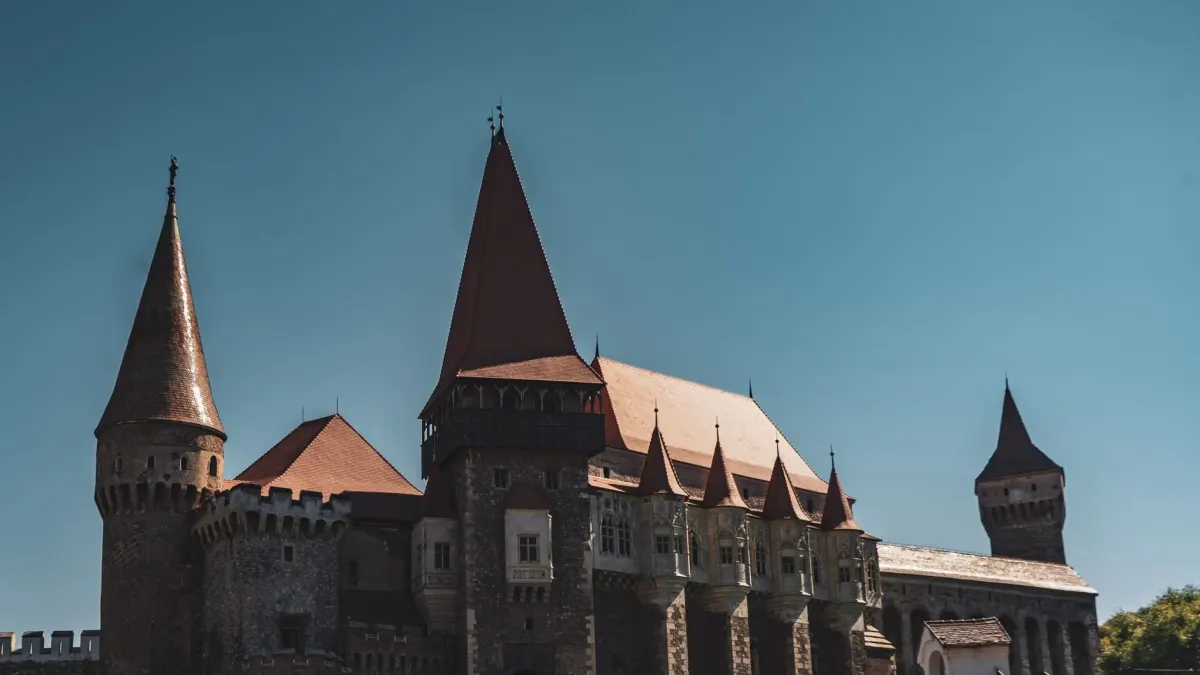
Some castles whisper. Corvin Castle makes an entrance. You come round a bend on the edge of Hunedoara, past apartment blocks and the ghosts of an old steelworks, and there it is: a cluster of pointed roofs, slender towers and painted shutters rising from a rock above the Zlaști stream, reached by a long wooden bridge propped on tall stone piers. It is the image that launched a thousand fairy-tale illustrations, and it is entirely real.
Often called Hunyadi Castle or, in Romanian, Castelul Corvinilor, it is widely considered the finest Gothic secular building in Romania and one of the most spectacular in Central and Eastern Europe. If Bran is the castle everyone knows, Corvin is the one that leaves seasoned travellers quietly speechless.
A fortress built for a hero
The story begins in the fifteenth century with John Hunyadi (Iancu de Hunedoara to Romanians), a military commander celebrated across the region for his campaigns against the Ottoman Empire. He transformed an older fortification on this rock into a residence worthy of his power, adding the Gothic halls, towers and defensive walls that define the castle today.
His son, Matthias Corvinus, became one of the great Renaissance kings of Hungary, and the family emblem, a raven holding a gold ring in its beak, appears throughout the building. Later owners added Renaissance and Baroque touches, and the castle survived fires, neglect and several waves of restoration. The result is a layered, slightly theatrical building where each century has left its fingerprint.
What not to miss inside
The Knights' Hall
The great hall on the ground floor is the castle's heart: a long vaulted space supported by a row of marble columns, built for banquets and ceremonies. Stand at one end and imagine it lit by torches, with a feast laid out beneath the ribbed vault.
The Diet Hall and the loggia
Above it sits the Diet Hall, used for assemblies, and nearby the open galleries and loggia look out over the valley. The Matthias wing, with its painted details, is one of the most elegant corners of the castle.
The well and its legend
In the courtyard stands a deep well with a famous legend attached. According to local tradition, it was dug by Turkish prisoners who were promised their freedom once they reached water. After years of labour they found it, the story goes, but the promise was not kept. An old inscription nearby is popularly translated as "you have water, but you have no soul." Historians treat the tale with caution, which does nothing to reduce its power when you peer into the darkness.
The towers and the bridge
Walk the ramparts and look back at the bridge from above. The defensive towers, each with its own name and story, give you the best sense of how this was a working fortress, not just a showpiece. Some accounts link the castle to Vlad the Impaler, who is said to have been held here for a time; treat it as legend rather than settled fact.
When to go
- Early morning is the golden hour here, before tour groups arrive and when the light catches the roofs.
- Autumn brings misty mornings and copper-coloured hills that suit the Gothic mood perfectly.
- Winter can be magical after snowfall, though some outdoor areas may be closed or slippery.
- The castle sometimes hosts medieval festivals and evening events in the warmer months. Check the official programme and opening hours before you go, as both change with the season and with ongoing restoration work.
Getting there from Bucharest
Hunedoara sits in western Transylvania, the better part of a day's drive from Bucharest. Rather than racing there and back, we suggest turning it into a short journey. A classic route crosses the Carpathians through the Olt Valley, pauses in Sibiu for the night, and continues to Hunedoara the next morning, arriving fresh and ahead of the crowds.
From there it is easy to add Deva Fortress, perched on a volcanic hill above the nearby city, or the Dacian and Roman sites of the Orăștie Mountains for travellers who love ancient history. Alba Iulia, with its vast star-shaped citadel, is another elegant stop on the way back east.
Tips for a better visit
- Wear shoes with grip: stairs are steep, stone floors are uneven and the bridge planks can be slippery in rain.
- Allow at least two hours inside, more if you love photography or history.
- Walk a few minutes along the road beyond the castle for the classic postcard view of the bridge and towers.
- Bring a light layer even in summer; thick stone walls keep the interior cool.
Travel to Corvin Castle privately with Kartas
Corvin Castle rewards travellers who arrive on their own terms: early, unhurried and without a group schedule hanging over them. Our concierge can arrange a private chauffeur for the journey on request, in a Mercedes with a driver who knows the road, the best photo stops and the right time to arrive. Stay an extra hour in the Knights' Hall, linger over lunch in Sibiu, or add Deva on a whim. The day simply bends around you.
Saplānosim kopā
Vēlaties, lai to noorganizējam Jums?
Pastāstiet savus datumus — nosūtīsim privātu plānu ar fiksētām cenām.