Nature · 11 November 2026 · 4 nóiméad le léamh · 1 léitheanna
The Transalpina: Driving Romania's Highest Road
Above the clouds on the King's Road: a guide to the Transalpina, Romania's highest paved road, with wild ridges, shepherds' huts and endless Carpathian views.
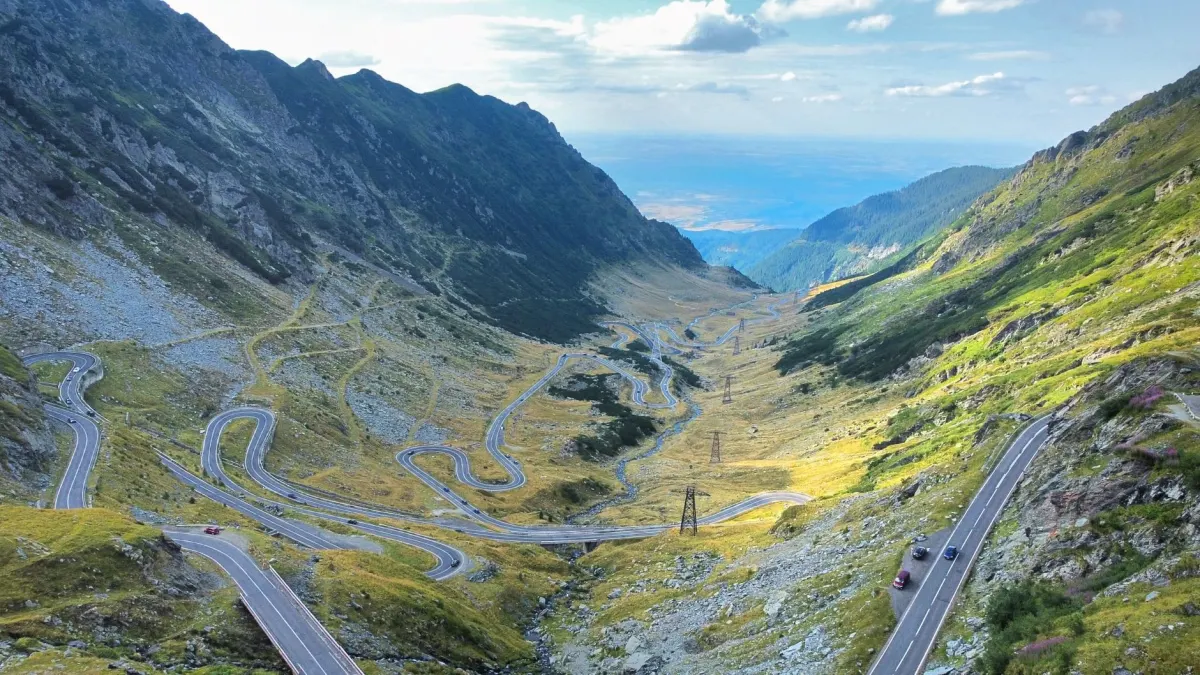
If the Transfăgărășan is Romania's most famous mountain road, the Transalpina is its wilder, more contemplative sibling. It climbs higher, feels emptier and runs for long stretches along open ridges where the only company is a shepherd, his dogs and a sky that seems close enough to touch. For many Romanians who know both roads, this is the one they secretly prefer.
Romania's highest road
The Transalpina, officially DN67C, crosses the Parâng Mountains between Novaci, in the region of Gorj in the south, and the Sebeș valley in Transylvania to the north. At the Urdele Pass it reaches around 2,100 metres above sea level, making it the highest paved road in Romania and one of the highest in the Carpathians.
The route follows an ancient path used by shepherds moving their flocks between summer and winter pastures. Local tradition calls it Drumul Regelui, the King's Road, linking it to the Romanian royal family and to works carried out by the army in the interwar years. Treat the exact story as part of the road's folklore; what is certain is that for decades it was little more than a rough mountain track, and it was only fully paved in the early 2010s, opening this high country to travellers for the first time.
What makes it special
The ridge above the clouds
North of Novaci, the road climbs quickly through beech and spruce forest, then breaks out above the tree line. From here, the Transalpina rides the crest of the mountains, with views falling away on both sides. On many mornings the valleys below fill with cloud, and you drive along a ridge that seems to float above a white sea.
Rânca
The small mountain resort of Rânca, high on the southern approach, is the natural pause for coffee and a first look at the panorama. In winter it becomes a modest ski area; in summer it is a gateway to the high road.
The lakes of the Lotru and Sebeș valleys
Descending northwards, the road passes the crossroads of Obârșia Lotrului, deep in the forest, before following a chain of reservoirs, among them Vidra on the Lotru side and Oașa in the Sebeș valley. These quiet lakes framed by dark pine forest feel almost Scandinavian, and make perfect places to stretch your legs.
Shepherds and their flocks
Transhumance is still alive here. In summer you will pass sheepfolds, wandering flocks and the occasional shepherd selling cheese by the road. Slow down, wave, and enjoy one of the most authentic pastoral landscapes left in Europe.
When the road is open
The high section of the Transalpina is closed for much of the year. It usually opens roughly from July to October, weather permitting, and can close at short notice because of snow, fog or maintenance works. Night driving on the high section may also be restricted. Always check the current status before setting off, and be ready to adapt the plan if the mountain decides otherwise.
Driving tips
- Weather changes fast. Thick fog can roll over the pass within minutes, and temperatures at the top can be far colder than in the valleys. Bring warm layers even in August.
- Services are few. Fuel stations and shops are scarce on the high section; plan stops in Novaci, Rânca or the Sebeș valley.
- Animals on the road. Sheep, cattle, horses and dogs are common, and bears live in these forests. Drive slowly and never feed wildlife.
- Take your time. Average speeds are low and the temptation to stop is constant. Treat the crossing as a full day.
Transalpina or Transfăgărășan?
The two roads are often compared, and the honest answer is that they offer different pleasures. The Transfăgărășan is the dramatic showpiece, with its famous hairpins, tunnel and glacial lake, and it draws bigger crowds. The Transalpina is higher, more open and usually calmer, with long ridge-top sections and a wilder atmosphere. If you have time for both, drive them on separate days; if you only have one, choose according to whether you prefer spectacle or solitude.
Building a journey around it
From Bucharest, the southern start of the Transalpina is a long drive west, so the road fits best into a multi-day route. One elegant option is to spend the night near the southern foothills, perhaps visiting the monasteries of Oltenia or the sculptures of Constantin Brâncuși in Târgu Jiu, cross the mountains the next morning in the best light, and finish in Sibiu for dinner. From there, the rest of Transylvania opens up.
Travel the King's Road privately with Kartas
A high mountain road with changeable weather and few services is exactly where a professional driver earns his place. Our concierge can arrange a private chauffeur for the Transalpina on request, with flexible timing that follows the weather rather than a group timetable, and plenty of stops for photographs, cheese from the sheepfolds and simply staring at the view. You sit back; the mountains do the rest.
Pleanáil linn é
Ar mhaith leat é seo a shocrú duit?
Inis dúinn do dhátaí — seolaimid plean príobháideach le praghsanna seasta.